
2026-06-23 · Instazzy Team · 11 min read
Best Time to Post on Instagram in 2026 (Real Data + What Actually Matters)
Everyone shares a 'best time to post on Instagram' table. Here is the 2026 data — and the part competitors skip: in 2026 it is the first-hour engagement test, not the clock, that decides your reach.
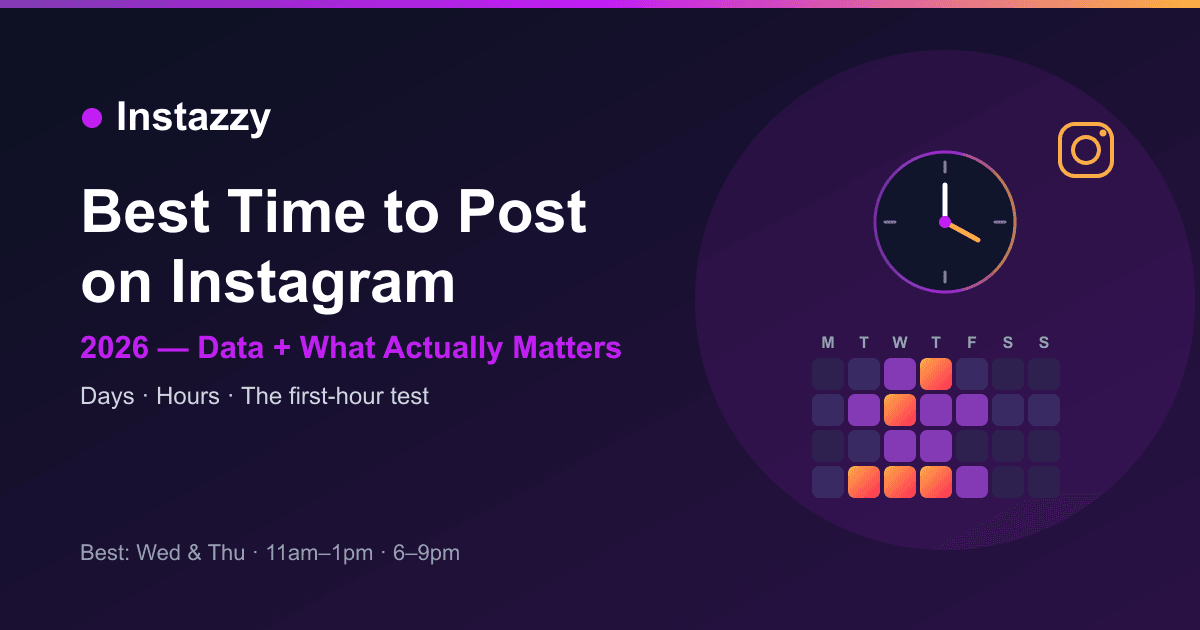
Search best time to post on Instagram and you get a hundred near-identical tables telling you to post Wednesday at 11 AM. We pulled the real 2026 data too — but this guide adds the part almost every competitor skips: in 2026, the Instagram algorithm rewards the first-hour engagement test, not the clock. Here is the data, and what actually moves reach now.
Best time to post on Instagram in 2026 (the quick answer)
Combining the largest 2026 studies (millions of posts analysed across Buffer, Later, Sprout Social and others), the windows that show up again and again are:
- Best days: Tuesday, Wednesday and Thursday — with Wednesday usually the single strongest day.
- Best hours: the 11 AM–1 PM lunch window and the 6–9 PM evening window (8–9 PM is often the heaviest).
- Worst times: the 1–5 AM dead zone every day, plus Friday evening through Saturday, when engagement collapses.
- Reels skew slightly later (evenings), while informational carousels do well around lunch.
Day-by-day quick windows
- Monday: 11 AM–1 PM (slow start to the week — keep it light).
- Tuesday: 10 AM–1 PM and 7–9 PM (strong all day).
- Wednesday: 11 AM and 7–9 PM — the best overall window of the week.
- Thursday: 9–11 AM and 6–9 PM (close second to Wednesday).
- Friday: 11 AM only — engagement fades through the afternoon.
- Saturday: weakest day; if you must, early afternoon.
- Sunday: 10 AM–1 PM as people scroll before the week starts.
The truth competitors skip: timing is not the real lever in 2026
Most 'best time to post' articles were written for an old, mostly-chronological feed. That feed is gone. In 2026 Instagram ranks content by predicted interest, and the signals it weighs most are not about the clock at all. Recency now buys you only a short head start — after that, your post sinks or climbs on how people respond.
- Watch time — the #1 signal for Reels. If viewers leave early, reach drops no matter when you posted.
- Sends per reach (DM shares) — a share into someone's DMs is worth far more than a like; this is the biggest 2026 shift.
- Likes and comments per reach — quality of response relative to how many saw it.
- Engagement velocity — how fast a post earns that response in the first 30–60 minutes.
So why does 'best time' still matter at all?
Because all four of those signals are measured early — and you can only earn them from people who are actually online. Post when your audience is scrolling and you get a real shot at fast watch time, sends and comments. Post at 3 AM and your first-hour sample is tiny and sleepy, so the post never builds momentum. Timing is not the prize; it is your ticket into the first-hour test that decides everything else. If your reach has been sliding, read why Instagram reach dropped suddenly — it is usually this test, not a shadowban.
By format: Reels vs feed vs Stories
- Reels: lean into evenings (6–9 PM) when people watch longer; watch time and sends decide reach. Stuck at low views? See why Reels get stuck.
- Feed posts & carousels: the lunch window (11 AM–1 PM) suits saveable, informational content.
- Stories: post around your audience's active peaks; Stories live on engagement (replies, taps) within hours, so timing matters most here.
How to find YOUR best time (the only table that matters)
- Open Instagram → Insights → Total followers → Most active times.
- Note your top 2–3 days and the peak hours on each.
- Schedule posts to land 15–30 minutes before those peaks for two weeks.
- Compare reach and watch time per post, not likes alone.
- Keep the slots that win, drop the rest — then retest every couple of months as your audience grows.
Your own Insights will always beat a global average, because a beauty creator in Istanbul and a gamer in Texas have completely different peak hours. Treat the data above as a starting hypothesis, then let your account prove the real answer.
Turn good timing into real reach
Perfect timing with a cold post still struggles — the first-hour sample sees 8 likes and scrolls on. That is why creators pair good timing with a credibility nudge: a gradual boost of Instagram views, likes and followers makes the post look worth watching during that exact first-hour test, which can earn more organic reach. Keep it gradual and paired with genuinely good content — that is the safe way. Want the full early-momentum playbook? See how to get real Instagram followers.
Common questions
What is the best time to post on Instagram in 2026?
What is the best day to post on Instagram?
Does posting time still matter with the 2026 algorithm?
How do I find my own best time to post?
Will posting at the right time make me go viral?
Ready to grow?
Social media growth strategies, platform updates and practical Instazzy guides to help you grow faster on Instagram, TikTok, YouTube and beyond.
Browse services →